Yemen Flag, Capital and Country Facts
Yemen is located in the southwest of the Arabian Peninsula between the Red Sea and the Gulf of Aden. High mountains, old terrace landscapes, desert spaces and the Sokotra archipelago belong to its geographical image. The red-white-black flag stands for the unification of 1990. Sanaa is the constitutional capital; war and political division necessitate an additional declaration of the seats of government.
Test your knowledge →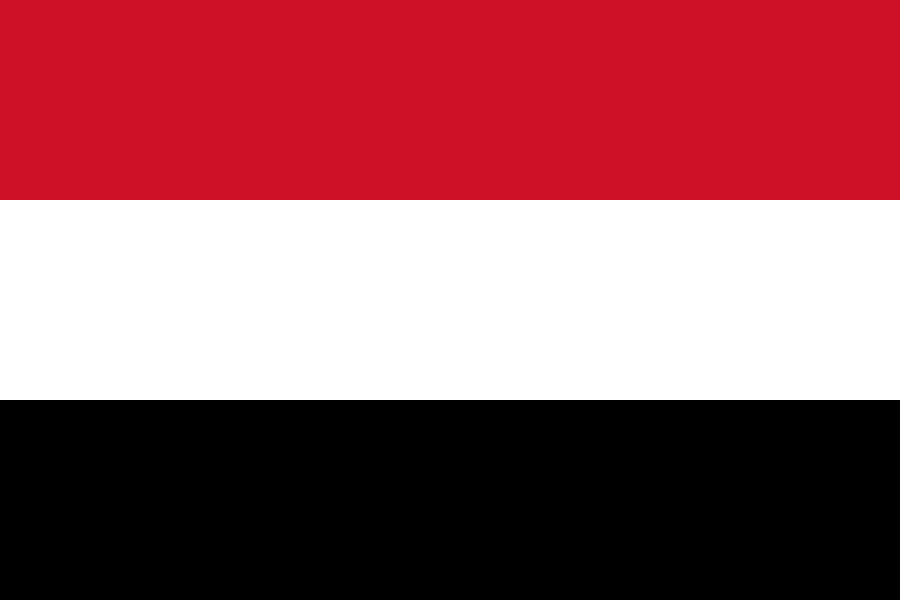
Yemen at a glance
- Constitutional capital
- Sana'a
- Quiz continent
- Asia
- Languages in reference record
- Arabic; regional languages among others Mehri and Sokotri
- Currency
- Yemen Rial (YER)
- Population
- 41,773,878 (2025, World Bank)
- Area
- 527,968 km²
- Coastal setting
- Not landlocked
- ISO codes
- YE / YEM
- Internet country suffix
- .ye
- Association
- 22 May 1990
- Highest mountain
- Jabal an-Nabi Shuʿaib, 3,666 m
- Provisional seat of government
- Aden
- Strategic Strait
- Bab al-Mandab
- Island group
- Sokotra
- Coastal level
- Tihama
Yemen Flag: Design, Meaning and History
Sana'a is the constitutional capital. Government functions are also carried out in Aden because of the conflict.
Three equally wide horizontal stripes are red, white and black. There is no star or eagle or scripture. It is precisely the lack of additional signs that distinguishes Yemen from the similarly striped flags of Egypt and Iraq. Who only recognizes the color sequence, should therefore search for an emblem in the white middle strip or determine its absence.
The flag was adopted at the Union of North and South Yemen in 1990. Their colours belong to the Arabic Liberation Flag tradition. In the Factbook archive, red is associated with victims of struggle, white with a hoped-for future and black with overcome oppression. This state interpretation explains the symbolism without presenting the current political situation as an already solved development.
Constitutional capital: Sana'a
Sanaa is located in a high-altitude valley in the western hill country. It is the constitutional capital and the answer used in the quiz. The old town is UNESCO World Heritage because of its characteristic multi-storey houses. The location differs climatically and structurally significantly from the hot coastal areas on the Red Sea and the Gulf of Aden.
Since the war, separate centres of power and administration have existed. Sanaa is under Houthi control; Aden serves as the provisional seat of the internationally recognized government. UNDP expressly refers to Aden as interim capital. Constitutional capital and actual seat of government must therefore not be equated without comment. Current front lines or incumbents are not required for this basic distinction.
Practise this capital →Yemen: Geography, History and Culture
The coastal plain of Tihama is dominated by the steep western mountains. In higher elevations, terraces for agriculture developed. Further east are drier highlands and desert spaces. On the strait Bab al-Mandab meet Red Sea and Gulf of Aden; the location is of great importance for international shipping routes.
Arabic is an official language, but not the only language of the country. In Sokotra, Sokotri is spoken, in the East among others Mehri. These are among the modern southern Arabic languages and are not mere Arabic dialects. The geographical distance of the islands and older regional connections explain part of this diversity.
The Republic of Yemen emerged from North and South Yemen on May 22, 1990. The factbook archive status of 2025 already describes serious consequences of the long-standing conflict. Nevertheless, an introduction must also make visible the long history before the war: Marib refers to the ancient Saba, Zabid to urban scholarship and Shibam to towering clay buildings. These places have different historical functions.
Sokotra
The Sokotra Archipelago is a UNESCO World Heritage Site. Its isolated location favored an independent animal and plant world, which differs significantly from the Arabian mainland.
Shibam
The walled old town of Shibam is a World Heritage site. Their multi-storey mud buildings are a striking example of compacted construction in a dry landscape.
Marib
The sites of the ancient kingdom of Saba near Marib were inscribed in 2023. They are reminiscent of early rule, trade and water management in southern Arabia.
Explore neighbouring and related places
 Oman
 Saudi Arabia
What did you discover?
Sources and image credits
This English article draws on the institutional sources listed below. Figures and memberships retain their stated reference dates.
Source record: 2 November 2026. A translation does not change the reference date of a figure or membership list.
- github.com/factbook/factbook.json/blob/144d6977b2b01ac1cbd220de754c0a005616760b/middle-east/ym.json
- data.worldbank.org/indicator/SP.POP.TOTL
- whc.unesco.org/en/statesparties/ye
- undp.org/yemen/our-sub-offices/aden-sub-office
- un.int/yemen/about
- github.com/mledoze/countries