Liechtenstein Flag, Capital and Country Facts
Liechtenstein is located between Austria and Switzerland on the Alpine Rhine. The small state connects a densely used valley area with high alpine areas and uses the Swiss franc. Vaduz is the main town; the blue-red flag carries a golden princely hat, which distinguishes the country from other simple two-color flags and makes its monarchical tradition visible.
Test your knowledge →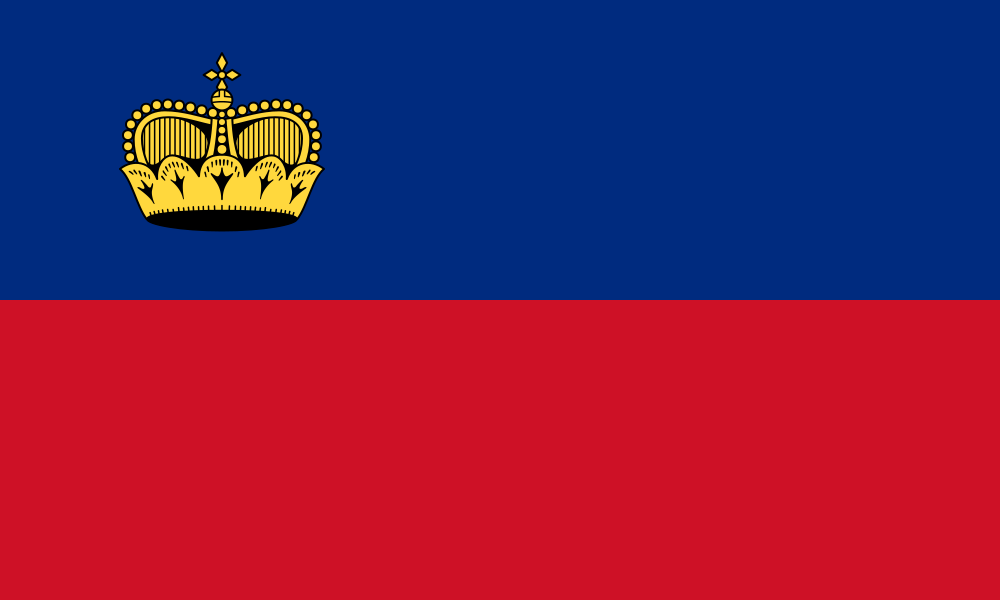
Liechtenstein at a glance
- Capital
- Vaduz
- Quiz continent
- Europe
- Languages in reference record
- German; in everyday life especially Alemannic dialects
- Currency
- Swiss Franc (CHF)
- Population
- 41,024 (2025, World Bank)
- Area
- 160 km²
- Coastal setting
- Landlocked
- ISO codes
- LI / LIE
- Internet country suffix
- .li
- Highest point
- Foregrause, 2,599 m
- Border flow
- Rhine
- Municipalities
- Eleven
- Land neighbours
- Austria and Switzerland
- Flag supplement
- Princess hat since 1937
- Special situation
- Twice within
Liechtenstein Flag: Design, Meaning and History
The flag consists of two equally high horizontal stripes: blue above and red below. In the blue stripe stands near the mast a golden princely hat. The official description expressly distinguishes this from any star or coat of arms; the small golden sign is particularly important for recognition.
The princely hat was added in 1937 after the similarity to the then flag of Haiti was noticed. The country colors blue and red were already in use before. Today, the prince's hat marks the national flag, while the state prince's standard also possesses other heraldic elements. National flag and personal ruling standards should therefore not be confused.
Capital: Vaduz
Vaduz is located on the eastern edge of the Rhine Valley below its widely visible castle. As the main town, it houses central state institutions. The castle is the official residence of the princely family and shapes the cityscape, but should not be equated with an ordinary freely accessible administrative building. The location connects the place directly with the Alpine slope.
Near Schaan forms another important settlement and economic area. In a small state, the capital and other important communities are often only short distances apart. The political significance of Vaduz can therefore not simply be derived from the size of a city. For the quiz, Vaduz remains the clear capital assignment, even if the term "central place" is often used.
Practise this capital →Liechtenstein: Geography, History and Culture
The Rhine forms the western border with Switzerland. East of it, the Alps rise steeply; the Vordergrauspitz reaches 2,599 meters. The country thus has a considerable difference in height despite its small area. Valley soil, slopes and high mountains fulfil different functions and differ in settlement density, traffic development and possible agricultural use.
Liechtenstein is doubly located within: its two neighbouring states Austria and Switzerland do not have their own access to the open sea. For the land route to a sea coast, therefore, at least one other state must be crossed. This rare location is a more precise geographical peculiarity than simply stating that Liechtenstein is a small landlocked state.
German is an official language, while various Alemannic dialects are common in everyday life. The use of the Swiss franc and the close transport links show the economic interconnection with the neighbouring area. At the same time, Liechtenstein has its own state institutions and eleven municipalities. Its small size therefore means neither a lack of political autonomy nor a complete equivalence with Switzerland.
Eleven municipalities
The country is divided into eleven municipalities. Vaduz belongs to the Upperland, while the Lowerland forms a second historical and political part of the country.
Valley and high mountains
The Alpenrhein and the Vordergrauspitz stand for very different elevations. Within short distances, the country changes from an internationally networked valley space to alpine landscapes.
Own state symbols
The state administration regulates colors and prince hat exactly. The princely hat described by law explains the flag more reliably than unoccupied interpretations of each individual color.
Explore neighbouring and related places
 Austria
 Switzerland
What did you discover?
Sources and image credits
This English article draws on the institutional sources listed below. Figures and memberships retain their stated reference dates.
Source record: 2 November 2026. A translation does not change the reference date of a figure or membership list.
- github.com/factbook/factbook.json/blob/144d6977b2b01ac1cbd220de754c0a005616760b/europe/ls.json
- data.worldbank.org/indicator/SP.POP.TOTL
- llv.li/de/landesverwaltung/stabsstelle-regierungskanzlei/wappen-und-farben-liechtensteins/farben
- statistikportal.li/de/uebergreifendes-indikatoren/liechtenstein-in-zahlen
- github.com/mledoze/countries