Vatican City Flag, Capital and Country Facts
Vatican City is a sovereign small state within Rome and at the same time completely surrounded by Italy. The yellow-and-white flag shows crossed keys and the papal tiara. Territory and ecclesiastical governance must be carefully distinguished: the Holy See is the international actor, while Vatican City ensures its territorial framework and independence.
Test your knowledge →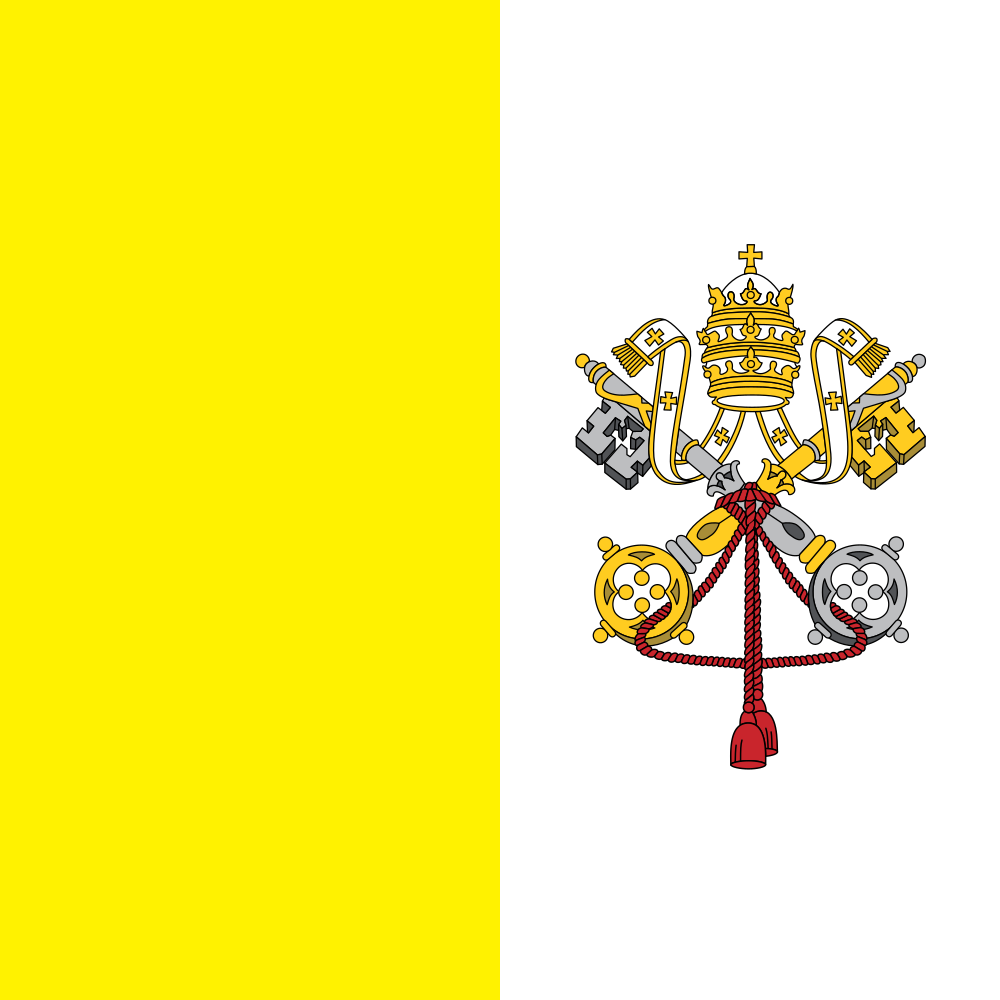
Vatican City at a glance
- Capital
- Vatican City
- Quiz continent
- Europe
- Languages in reference record
- Italian in everyday life; Latin in the ecclesiastical and official environment of the Holy See
- Currency
- Euro (EUR)
- Area
- 0.44 km²
- Coastal setting
- Landlocked
- ISO codes
- VA / VAT
- Internet country suffix
- .va
- Establishment of the State
- Lateran Treaties, February 11, 1929
- UNESCO Registration
- Vatican City, 1984
- Surrounding State
- Italy
- Surrounding city
- Rome
- Known place
- St. Peter's Square
- Flag format
- Quadratic
Vatican City Flag: Design, Meaning and History
The flag shown here is square and vertically divided into yellow left and white right. In the white field stand two crossed keys under the triple papal tiara. One of the keys is gold-colored, the other silver-colored; a red string connects them. The key group is the crucial detail besides the unusual square shape.
Today’s color combination dates back to changes in 1808 under Pope Pius VII. The official Vatican account explains the change from older yellow-red colors to yellow and white. The keys refer to the apostle Peter. The sign belongs to the papal tradition and is to be distinguished from the personal coat of arms of a respective sitting pope.
Capital: Vatican City
Vatican City is both state and capital at the same time. A separate, spatially separated capital core does not exist. St. Peter's Square is located immediately at the crossing to the Italian city of Rome. The visible urban environment thus continuously crosses state borders, while international law autonomy is organized in a very small area.
The Lateran Treaties of 1929 created the present state and regulated the relationship with the Kingdom of Italy. However, the Holy See is older than this territory. Diplomatic relations are maintained by the Holy See; the terms Vatican City and Holy See are therefore closely related, but not interchangeable in every legal or organizational statement.
Practise this capital →Vatican City: Geography, History and Culture
The area is located on the Vatican Hill in western Rome. It includes, among others, St. Peter’s Basilica, Apostolic Palace, museums and gardens. Natural landscape and dense monumental urban fabric interlock in a small space. There is neither the coast nor the agricultural hinterland of an ordinary territorial state. The state is completely surrounded by built-up Roman urban area; a transition to open rural neighbourhoods is missing.
Italian characterizes many practical administrative and everyday processes. Latin continues to have importance in the ecclesial environment of the Holy See. People from numerous countries work for Vatican and church institutions. Resident population, nationals and employees are therefore different groups; a single undated number would obscure this peculiarity rather than explain it.
UNESCO has listed Vatican City as a World Heritage Site since 1984. A second entry connects historic Rome with certain possessions of the Holy See outside the territory of the State. Extraterritorial rights do not automatically mean an extension of the state border. The factbook archive of 2025 serves here for basic historical and geographical indications, not for a supposedly current population census.
An entire state as a world heritage
The UNESCO entry Vatican City captures the small state as an important cultural area. Architecture, art collections and gardens are part of this extraordinary ensemble.
Peter's key
The crossed keys appear on the flag and insignia. Their reference to Peter explains why the motive endures beyond individual office holders.
Lateral contracts
The agreements of 1929 established the current state form. They must be distinguished from the much older history of the papacy and the former Papal State.
Explore neighbouring and related places
 Italy
What did you discover?
Sources and image credits
This English article draws on the institutional sources listed below. Figures and memberships retain their stated reference dates.
Source record: 2 November 2026. A translation does not change the reference date of a figure or membership list.
- github.com/factbook/factbook.json/blob/144d6977b2b01ac1cbd220de754c0a005616760b/europe/vt.json
- whc.unesco.org/en/statesparties/va
- vaticanstate.va/en/state-and-government/general-informations/flag.html
- vaticanstate.va/en/state-and-government/general-informations.html
- github.com/mledoze/countries