South Korea Flag, Capital and Country Facts
South Korea occupies the southern part of the Korean Peninsula and also includes numerous islands. Seoul is the capital, while Sejong assumes part of the administrative functions. The flag called Taegukgi connects a red-blue circle with four black trigrams; its exact arrangement distinguishes it from a mere two-color flag.
Test your knowledge →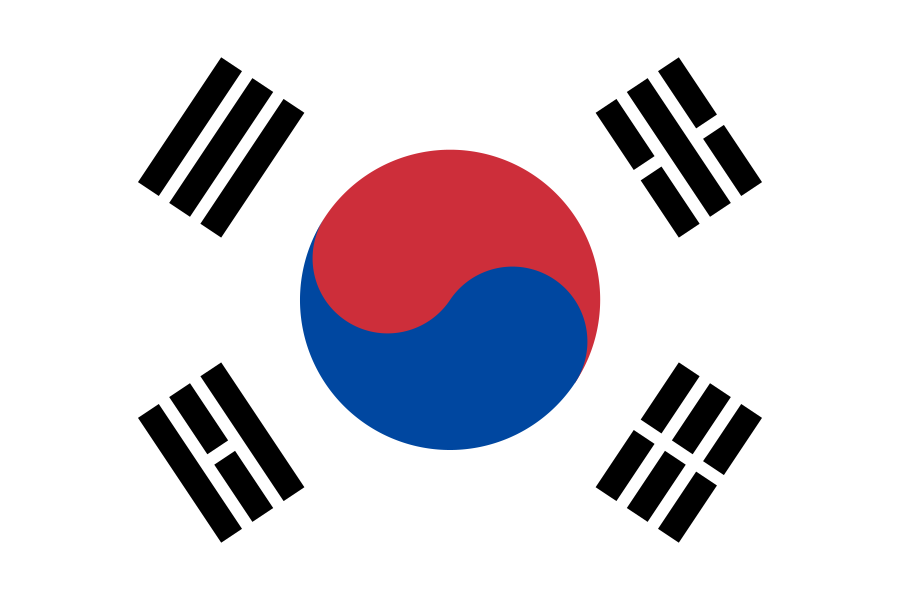
South Korea at a glance
- Capital
- Seoul
- Quiz continent
- Asia
- Languages in reference record
- Korean
- Currency
- South Korean won (KRW)
- Population
- 51,684,564 (2025, World Bank)
- Area
- 100,210 km²
- Coastal setting
- Not landlocked
- ISO codes
- KR / KOR
- Internet country suffix
- .kr, .한국
- Official designation
- Republic of Korea
- Flag names
- Taegukgi,
- Capital river
- Han
- Administrative centre
- Sejong
- Highest point
- Hallasan, 1,950 m
- Volcanic Islands
- Jeju
South Korea Flag: Design, Meaning and History
On a white background lies a red-blue circular sign divided into two curved halves. Red is at the top, blue at the bottom. In the four corners, black trigrams of three whole or interrupted bars appear. The different beam patterns belong to the motif and are not an arbitrarily interchangeable ornament.
The flag is called Taegukgi. The circular sign describes the interaction of opposing forces, the trigrams are connected to heaven, earth, water and fire. White is a traditional Korean color. Together, a symbolic system of movement and harmony results; the colors of the middle symbol are therefore not to be understood as a representation of two present-day states on the peninsula.
Capital: Seoul
Seoul is located on the Han River in northwestern South Korea. The city was already a political center in the Joseon period and connects historical palaces with a large modern metropolitan region. Its location relatively close to the border with North Korea is important for spatial classification, but it must not be confused with a location directly on the border line.
Sejong has been taking on important administrative functions since the relocation of various authorities. Seoul nevertheless remains the capital in the quiz and a central political, economic and cultural location. Similar to other states with distributed government tasks, the conceptual separation helps: The seat of individual ministries and the name of the capital do not have to completely coincide.
Practise this capital →South Korea: Geography, History and Culture
A large part of South Korea is hilly or mountainous. Broader coastal plains are mainly located in the west and south, where important traffic and settlement areas are concentrated. The coast is divided by many islands and bays. The highest mountain, the 1,950 meter high Hallasan, is not on the mainland, but on the southern volcanic island of Jeju.
Jeju and its lava tubes are part of the UNESCO natural heritage. The Korean mudflats, Getbol, show another significant coastal habitat. The comparison makes it clear that proximity to the sea produces very different landscapes: volcanic islands, shallow tidal spaces and densely built-up port regions can be part of the same country. South Korea’s sea links also extend far beyond the peninsula.
Korean is written with the Hangeul font, which is fundamentally different from Chinese characters. Cultural history includes Buddhist temples, Confucian educational institutions and royal facilities. Modern industrial and media production does not simply follow a single tradition without interruption; historical sites provide concrete insights into different eras and institutions. The official designation is Republic of Korea.
Changdeokung
The Seoul Palace complex has been on the World Heritage List since 1997. It makes the historical function of the capital within today’s metropolis visible.
Tripitaka Koreana
The depot buildings of the Haeinsa Temple have been a World Heritage site since 1995. They are related to the preservation of an important collection of Buddhist pressure sticks.
Gyeongju
The historical areas of Gyeongju became World Heritage sites in 2000. They unlock the history of an older political center and expand views beyond Seoul and the Joseon period.
Explore neighbouring and related places
 North Korea
Cities and regions in this country
 Seoul
What did you discover?
Sources and image credits
This English article draws on the institutional sources listed below. Figures and memberships retain their stated reference dates.
Source record: 2 November 2026. A translation does not change the reference date of a figure or membership list.
- github.com/factbook/factbook.json/blob/144d6977b2b01ac1cbd220de754c0a005616760b/east-n-southeast-asia/ks.json
- data.worldbank.org/indicator/SP.POP.TOTL
- whc.unesco.org/en/statesparties/kr/
- github.com/mledoze/countries