Qatar Flag, Capital and Country Facts
Qatar lies on a flat peninsula on the western side of the Persian Gulf. Doha is the political and economic center on the east coast. Dry landscapes, maritime trade history and the modern natural gas economy belong together to the country profile. The white-wine-red flag stands out due to its nine teeth and unusually long shape.
Test your knowledge →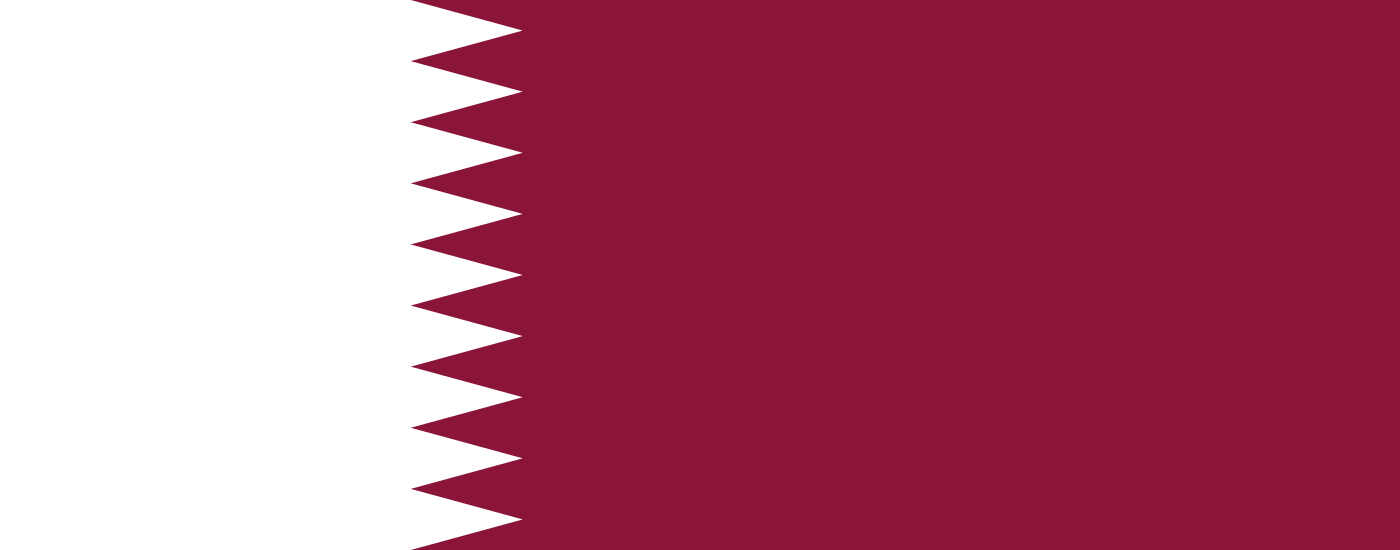
Qatar at a glance
- Capital
- Doha
- Quiz continent
- Asia
- Languages in reference record
- Arabic (official language); English as a common language of communication
- Currency
- Qatar Riyal (QAR)
- Population
- 2,972,215 (2025, World Bank)
- Area
- 11,586 km²
- Coastal setting
- Not landlocked
- ISO codes
- QA / QAT
- Internet country suffix
- .qa, قطر.
- Single land border
- Saudi Arabia
- Marine space
- Persian Gulf
- National holiday
- 18 December
- Independence
- 3 September 1971
- Flag splines
- 9
- World Heritage
- Al Zubarah, since 2013
Qatar Flag: Design, Meaning and History
On the left is a white field, on the right is a larger wine-red. A jagged border with nine white tips separates the surfaces. The flag is much longer than high. Straight wine red and the number of spikes are helpful in distinguishing them from Bahrain’s similar but red flag with five tips.
The Factbook Archive combines white with peace and wine red with historical struggles. The nine peaks are explained as a reference to Qatar’s historical position in the British-influenced Gulf Treaty Room. This interpretation belongs to the political symbolic history. In the small quiz picture, however, the dark red color and the long jagged dividing line are visible first.
Capital: Doha
Doha is located on the east coast of the peninsula on the Persian Gulf. The name is associated with the Arabic word ad-dawha, "the great tree". The city developed from a coastal town and is today the capital as well as the most important urban center of the country.
The coastal location explains historical links to fishing, seafaring and pearl trade. Modern urban development, on the other hand, is strongly related to revenues from oil and natural gas. Old maritime activities and today's high-rise buildings are therefore not separate images, but different phases of the development of the same coastal location.
Practise this capital →Qatar: Geography, History and Culture
Qatar has mostly flat, dry terrain with stone and sand areas. There are no large permanent rivers. The only land border leads to Saudi Arabia; all other directions are determined by the Gulf. The location as a peninsula is therefore just as important for borders, traffic and historical external contacts as the desert climate.
The summers are very hot, the precipitation is low. Water availability and technical supply therefore play a central role in urban life. However, the natural drought does not mean that the country’s history took place exclusively inland. Coastal towns, trade and pearl fishing shaped former forms of employment long before the current importance of fossil fuels.
Qatar became independent from the British Protectorate on 3 September 1971. The National Day on December 18, on the other hand, commemorates another historical date of 1878. Arabic is an official language, while a large immigrant population brings other languages into everyday life. The international natural gas industry explains these connections better than a presentation oriented exclusively to traditional coastal occupations.
Al Zubarah
The archaeological site Al Zubarah was registered as a UNESCO World Heritage Site in 2013. It documents a historical trade and coastal settlement. The location in the northwest complements the highly Doha-focused perception of Qatar with an older urban focus.
Nine instead of five points
Qatar's flag has nine tips on the white dividing line; Bahrain's flag has five. In addition, there is wine red compared to a lighter red. Both characteristics should be learned together, because the basic division of neighboring flags works very similarly.
Two important data
September 3, 1971 marks independence, December 18 the national holiday. These data must not simply be equated. The example shows that a national holiday can also date back to dynastic or state traditions before formal independence.
Explore neighbouring and related places
 Saudi Arabia
What did you discover?
Sources and image credits
This English article draws on the institutional sources listed below. Figures and memberships retain their stated reference dates.
Source record: 2 November 2026. A translation does not change the reference date of a figure or membership list.
- github.com/factbook/factbook.json/blob/144d6977b2b01ac1cbd220de754c0a005616760b/middle-east/qa.json
- data.worldbank.org/indicator/SP.POP.TOTL
- whc.unesco.org/en/statesparties/qa
- github.com/mledoze/countries