Stockholm: City Flag, History and Identity
Stockholm is located at the junction between Lake Mälar and the Baltic Sea and is the capital of Sweden. The water situation explains much of its early trading history and its present form. Gamla stan preserves the older city centre, while the town hall forms a younger landmark. On the blue city flag, the crowned head of St. Erik appears as an independent communal sign.
Test your knowledge →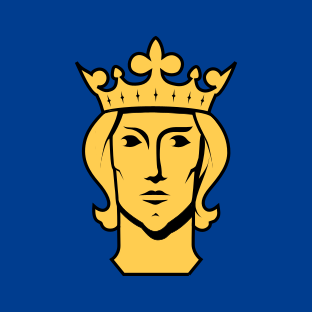
Stockholm at a glance
- Name
- Stockholm
- Country
- Sweden
- Profile type
- City
- Waters
- Malelars and the Baltic Sea
- Oldest town centre
- Stadsholmen, today Gamla stan
- First attribution in writing
- 1252
- Erik seal imprint
- 1376
- Formal acceptance of symbols
- 1923
- Confirmation of the city symbol
- 1934
- City Hall inauguration
- 1923
- Town Hall Tower
- 106 meters high
The Flag of Stockholm
The flag shown bears a golden crowned head on a blue background. It is a question of St. Erik, not the representation of any present monarch. The image consists of the head with crown; a whole body or an additional cross does not belong to this file. The combination of motif and blue field makes them unmistakable.
The city traces the representation of Erik to medieval seals. The oldest known corresponding imprint dates from 1376. It was not until 1923 that Erik was formally adopted as a symbol of the city, the confirmation followed in 1934. The current administrative mark is also linked to this, but the flag image and modern logo version are different applications of the same historical motif and not identical in every detail.
Stockholm: Location and Territorial Role
Stockholm emerged at an important traffic transition between the Mälaren and the Baltic Sea. The waterways connected the inland with further trade routes. This situation explains better than a mere list of islands, why an important transhipment point could be created here. The city controlled a space through which goods from different parts of Sweden were transported.
The oldest city centre was located on Stadsholmen, where Gamla stan is today. The first written mention of the name Stockholm is preserved in two letters of 1252. This is a source document, not proof that on this very day all urban structures suddenly emerged. Archaeological finds supplement the written tradition with older and everyday traces.
Landscape, History and Culture
The Mälarsee was originally a sea bay. Due to the land elevation, it was gradually separated from the Baltic Sea in the Middle Ages and became a freshwater lake. This change reinforced the importance of the Stockholm outflow area. Natural history and urban history are closely connected here: the position as a trading centre also arose from long-term changes in the water space and its connection to the sea.
Gamla stan preserves traces of medieval development and paths. Walls, cellars, finds of craft and other archaeological evidence help to reconstruct the former life. However, many buildings have been altered or replaced. The old town should therefore not be understood as a completely unchanged medieval age, but as a grown urban space in which different times are visible and hidden next to each other.
Stockholm City Hall was inaugurated in 1923. Its 106-meter-high tower is one of the defining elements of the silhouette. The city describes architectural history, craftsmanship and symbolism as closely connected. The building thus stands for a younger phase of communal representation, which differs from the medieval trading city and nevertheless builds on a strong historical self-image.
Gamla stan
The location on Stadsholmen makes the spatial limitation of the early centre understandable. During construction work, older traces are always discovered there. A walk through the streets can therefore be combined with the idea that more city stories lie under the today's surface. Visible architecture and archaeological research complement each other in explaining this oldest core.
Stadshuset
The town hall was built during a period of strong urban growth and was opened in June 1923 after a long construction period. Its tower and carefully designed interiors make it a comprehensive representational building. It shows how a modern commune wanted to bring together history, craftsmanship and public tasks in a new architectural centre.
Mallars and city symbols
The transition between inland waters and sea explains Stockholm’s position as a trading centre, while Erik stands for the historical self-expression of the city. Both levels complement each other, but are different: waterways explain the situation, the coat of arms motif conveys communal identity. It is precisely this distinction that helps to classify the flag without explaining its blue surface by an unoccupied simple color legend.
Explore this country and nearby profiles
 Sweden
What did you discover?
Take this flag into the quiz
Sources and image credits
This English article draws on the institutional sources listed below. Figures and memberships retain their stated reference dates.
Source record: 2 November 2026. A translation does not change the reference date of a figure or membership list.
- varumarkesmanual.stockholm/grafisk-profil/logotyp/
- stockholmskallan.stockholm.se/teman/stockholms-aldsta-historia/stockholm-blir-en-stad/
- stadshuset.stockholm/utforska-stadshuset/stadshusets-historia/
- malaren.se/startsida/om-malaren/fornlamningar/
- commons.wikimedia.org/wiki/File%3AFlag_of_Stockholm.svg