Helsinki: City Flag, History and Identity
Helsinki is located on the Finnish Baltic coast and is the capital of Finland. The city emerged as a trade foundation and later developed into an administrative center. Its maritime history is particularly evident on the fortified islands of Suomenlinna. The blue coat of arms with boat and crown shown here, on the other hand, belongs to the ceremonial urban symbolism and complements the modern Helsinki appearance.
Test your knowledge →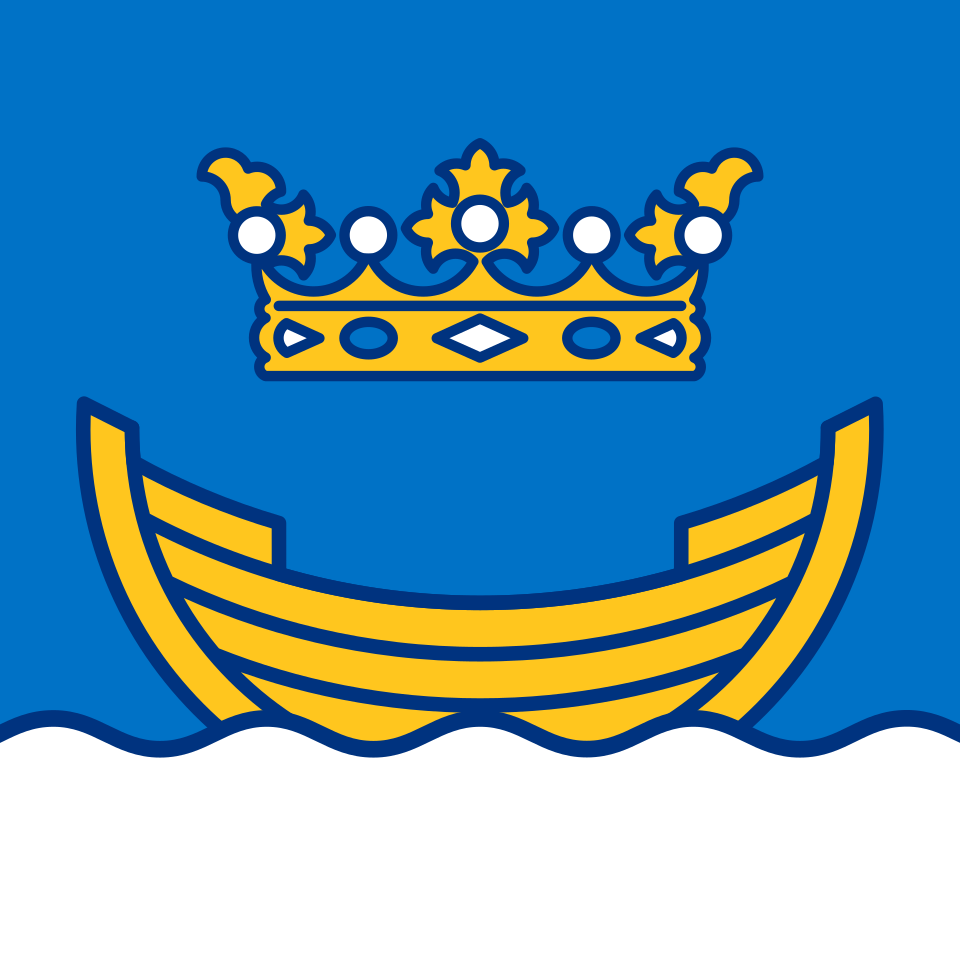
Helsinki at a glance
- Name
- Helsinki
- Country
- Finland
- Profile type
- City
- Coastal waters
- Gulf of Finland
- Year of establishment
- 1550
- Founder
- King Gustav Vasa
- First location
- Vanhakaupunki at the Vantaanjoki estuary
- Commercial competitor
- Tallinn
- Capital decision
- 1812 in the Grand Duchy of Finland
- Start of fortification work
- Suomenlinna 1748
- World Heritage Fortress
- 1991
The Flag of Helsinki
The figure shows a blue cloth with a golden boat, a golden crown above it and a white corrugated surface at the bottom. The motif takes over the city coat of arms flat. It is the ceremonial flag chosen here, not the Finnish national flag with a blue cross or a flag with the modern Helsinki font logo.
The city uses its traditional coat of arms today especially on festive occasions, such as state visits, anniversaries and on official seals. In many everyday contexts, the framed Helsinki logo has taken on other tasks. However, no statement follows from these design guidelines that any blue flag with city names would be the same flag; coat of arms, logo and flag image are to be distinguished.
Helsinki: Location and Territorial Role
Helsinki is located on the coast of the Gulf of Finland opposite the wider area of Tallinn. This relationship with the opposite Baltic coast was already important when it was founded. King Gustav Vasa wanted to create a trading place in 1550 that could compete with Tallinn. The maritime situation is thus not only a landscape framework, but also part of the original economic policy intention.
The first location was in the area of Vanhakaupunki at the mouth of the Vantaanjoki. It does not simply correspond to today's monumental center. Anyone who follows the founding history on a map will therefore discover several spatial layers. For a long time, an initially small trading town became a center whose administrative and cultural functions extend far beyond the original settlement site.
Landscape, History and Culture
The islands off Helsinki are essential to the image of the city. Suomenlinna is an inhabited fortress landscape on several islands and not just a single castle. Waterways, walls, courtyards and former military buildings form a connection there. This situation explains why maritime defence played a major role in the development of Helsinki and remains highly visible to this day.
In 1812, Helsinki was designated the capital of the Grand Duchy of Finland. The change of status set in motion an extensive restructuring and new administrative functions. Finland was then under Russian rule; the present independent state did not yet exist. This historical distinction is important when talking about the beginning of Helsinki as a capital and different political epochs would otherwise easily flow into one another.
The construction of the Suomenlinna sea fortress began in 1748 under Swedish rule. Later, a Russian and a Finnish phase followed. Since 1991, the site has been a UNESCO World Heritage site. Their history is therefore a particularly vivid access to the changing domination of Finland, without reducing the islands to their original military task.
Vanhakaupunki
The name means old city area and refers to the first location of the trade foundation. The mouth of the Vantaanjoki explains the choice of location at that time. This area helps to consider the development of Helsinki not exclusively from today’s centre. The founding of the city and today’s capital belong together, but are neither temporally nor spatially simply one above the other.
Suomenlinna
The fortress was built for the Swedish naval defense and the archipelago. After changing political affiliations, it also developed under civil administration into a place of residence and visitation. Those who travel there thus move through a world heritage that is also a district. The combination of heritage protection and everyday life is part of its special character.
Capital and city symbol
The Capital Resolution of 1812 and today’s ceremonial use of the coat of arms show two different levels of urban representation. On the one hand, new administrative tasks and a representative center were created, on the other hand, a historical symbol remained present in solemn contexts. The coat of arms flag can therefore be understood as part of the local symbolic world without confusing it with today's administrative logo.
Explore this country and nearby profiles
 Finland
What did you discover?
Take this flag into the quiz
Sources and image credits
This English article draws on the institutional sources listed below. Figures and memberships retain their stated reference dates.
Source record: 2 November 2026. A translation does not change the reference date of a figure or membership list.
- historia.hel.fi/en/kaannekohdat/origins-and-16th-century/1550-founding-helsinki
- historia.hel.fi/en/kaannekohdat/1800-luku/1812-capital-city
- suomenlinna.fi/en/explore/history/
- hel.fi/en/decision-making/information-on-helsinki/design-and-digitalisation/helsinki-brand-and-visual-identity/visual-identity-guidelines/use-basic-elements
- commons.wikimedia.org/wiki/File%3AFlag_of_Helsinki.svg