Johannesburg: City Flag, History and Identity
Johannesburg emerged as a rapidly growing gold mining settlement and became an important center of South Africa. The city in Gauteng connects industrial and migration history with important places on the road to democracy. Its colourful flag belongs to the newly ordered city administration after apartheid and thus refers to a different political framework than older communal symbols.
Test your knowledge →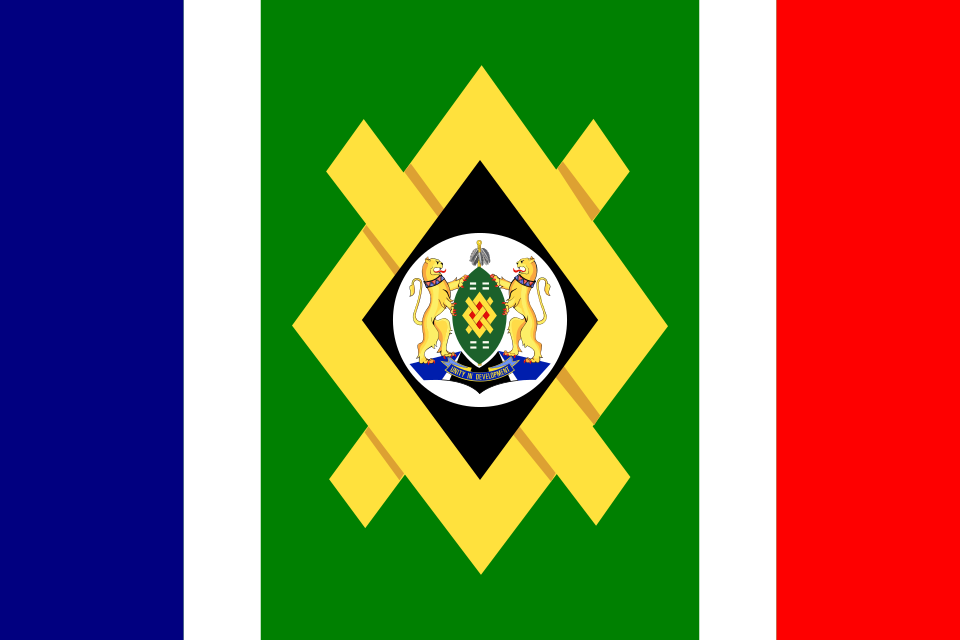
Johannesburg at a glance
- Name
- Johannesburg
- Country
- South Africa
- Profile type
- City
- Province
- Gauteng’
- Historical Gold Region
- Witwatersrand
- Triggers for rapid urban growth
- Golden Discovery 1886
- Early Place of Soweto History
- Kliptown, set up in 1903
- Forced relocations after epidemic
- 1904
- Court on Constitution Hill
- Constitutional Court of South Africa
- Previous Use of Constitution Hill
- Prison and fortification grounds
- Neighbourhood of the court location
- Braamfontein, Hillbrow and Parktown
The Flag of Johannesburg
The selected flag shows vertical areas in blue, white, green, white and red. In the broad green center lies a golden, intertwined acting figure with a central coat of arms. The narrow white dividing stripes and the golden shape are good distinguishing features; a mere blue-green-red tricolor would incompletely describe the picture.
This flag was introduced in 1997 in connection with the new metropolitan symbols. It follows an older green gold flag of the former city administration. The reorganization connected previously separate municipal spaces. Therefore, today’s flag motif is to be understood in the context of a joint city representation, not as an unchanged continued sign of the original mining settlement.
Johannesburg: Location and Territorial Role
Johannesburg is located in the province of Gauteng in the northeastern inland country of South Africa. The city developed on the Witwatersrand, whose gold deposits determined its early economy. The name Johannesburg today encompasses a large metropolitan administrative area. Places like Soweto and the inner-city quarters belong to this broader city history, although they experienced very different developments.
The spatial structure arose, among other things, through mining, immigration and the forced separation of population groups. A historical view must therefore go beyond the centre’s commercial buildings. The history of Soweto shows how exclusion and resettlement shaped the city. Constitution Hill, on the other hand, makes visible the change of a former place of detention to the seat of a democratic court.
Landscape, History and Culture
The discovery of gold in 1886 triggered a strong influx of people. From a new settlement developed in a short time a large city. Unlike port cities, Johannesburg initially owed its growth spurt to raw material deposits in the country. The landscape of the Witwatersrand is thus a key to its economic development.
The municipal chronology of Soweto describes the formation of Kliptown in 1903 and the forced displacement of residents from inner-city quarters after a plague epidemic in 1904. This prehistory precedes the later apartheid policy. Soweto can therefore not be explained as an accidental suburb; state intervention and unequal housing rights significantly shaped its development.
Constitution Hill combines memory and current constitutional order. On the premises of a former prison is the Constitutional Court. The judges deliberately chose this place because of its burdened history. The contrast between imprisonment, disenfranchisement and the protection of fundamental rights is not only told there, but also experienced spatially through the use of the same terrain.
Witwatersrand and Gold History
The golden discovery of 1886 explains the unusually fast rise of Johannesburg. It attracted people with very different hopes and led to a city whose economic importance extended early on beyond the region. Those who follow their history should therefore consider both the promotion of raw materials and migration.
Soweto's Creation
Kliptown is one of the important early sites in Soweto’s history. The communal timetable shows that resettlement and discriminatory intervention changed residential geography as early as the early twentieth century. Today's Soweto is therefore also an access to the question of who was allowed to live within the growing city and under what conditions.
Constitution Hill
At the crossing between Braamfontein, Hillbrow and Parktown lies a place with opposing historical meanings. The former prison grounds and the Constitutional Court are directly related here. Constitution Hill thus helps to understand Johannesburg as both a local urban landscape and a theatre of South African democratic history.
Explore this country and nearby profiles
 South Africa
What did you discover?
Take this flag into the quiz
Sources and image credits
This English article draws on the institutional sources listed below. Figures and memberships retain their stated reference dates.
Source record: 2 November 2026. A translation does not change the reference date of a figure or membership list.
- joburg.org.za/about_/Pages/About%20the%20City/About%20Joburg/Brief-History.aspx
- joburg.org.za/play_/Pages/Play%20in%20Joburg/Culture%20and%20Heritage/Links/Chronology-of-events-in-the-making-of-Soweto-.aspx
- concourt.org.za/index.php/33-the-building/history-of-the-site
- crwflags.com/fotw/flags/za-gt-jb.html
- commons.wikimedia.org/wiki/File%3AFlag_of_Johannesburg%2C_South_Africa.svg